
Building vs. Buying a First Aid Kit: The Question Every Sailor Asks

If you spend enough time teaching maritime medicine, you start a few questions that are asked over and over again. One of the most common?
"Should I build my own first aid kit… or just buy one?"
It's a fair question. And like a lot of unsatisfying answers in medicine — it depends. Let's unpack it. But first, a quick reality check.
What's in a Name? Less Than You Think.
If you've ever scrolled the West Marine first aid page, you already that the words "offshore," "cruising," and "bluewater" on a kit label don't mean much. They get used loosely. A "Bluewater" kit and a "Coastal" kit from the same brand might differ by ten band-aids and a cold pack. The moral of this story? Don't put much weight on the name on the front. The contents list is the only thing that tells you anything.
The Smoke, the Mirrors, and the Tourniquet That Isn't
We started stocking first aid kits to support graduates of our maritime courses who wanted to walk away with something that matched their training. From a business perspective, it was a hassle. Low margins, expiration dates ticking, and a flood of cheaper, aggressively marketed competitors to compete with. There are some genuinely good kits on the market. There are also some who are running a soft scam.
Case in point: one of the most popular first aid kit brands on the market (you've likely seen the boxes at West Marine, on Amazon, you've probably even owned one!), includes "tourniquet" on the contents list when what's actually inside is an IV tourniquet.
An IV tourniquet is a large rubber band used during venous blood draws. Applied to an arterial bleed at sea, it would likely speed up bleeding by blocking venous return while still allowing arterial flow. That's the opposite of what you want! At sea, where evac time is measured in hours or days, getting bleeding under control fast matters.
Real tourniquets, like CAT, SOFT-T, SAM XT, have a higher price tag. They're approved by the Committee on Tactical Combat Casualty Care (CoTCCC). They're $30+, hard to improvise on a heeling boat, and most of you will never use one. But when you need one, nothing else does the job. A rubber band labeled "tourniquet" is, at best, misleading. At worst, it's negligence dressed up as budget-friendly preparedness.
Which is why we started selling first aid kits.
Improvising Your Kit: The Good, the Bad, and the Bulk Packaging Problem
Let's be clear: improvising is a core maritime medical skill. Knowing how to turn a winch handle, a spinnaker pole, or the mast of a dinghy into a splint? Excellent. We want you to know that stuff cold. But improvising the whole kit from scratch comes with a few predictable drawbacks.
1. It actually costs more- Buying piece by piece sounds thrifty until you realize medical supplies come in oddly enormous quantities:
Need a few gauze pads? Minimum order is 50.
Want a packet of wound wash? Hope you enjoy receiving twelve.
Looking for tape? Congratulations, you now own enough for the next natural disaster.
Pre-built kits often beat your DIY attempt on price alone because they buy in bulk so you don't have to.
2. You'll overthink everything- The paradox of choice will eat you alive. Cotton triangular or muslin? Pre-tied? Tactical-tan or hospital-white? At some point your "simple boat list" turns into you staring at a marine catalog at 1 a.m. debating the emotional significance of ACE wrap elasticity. Meanwhile, the boat still needs to be provisioned.
3. You'll still end up missing something- Usually the thing you end up needing most, becuase it’s hard to anticipate every need for situations you’ve never been in.
Our Suggestion: Buy, Then Modify
After years of field testing, from coastal day-sails out of Monterey Bay to passages across open water, the recommendation we give students is simple:
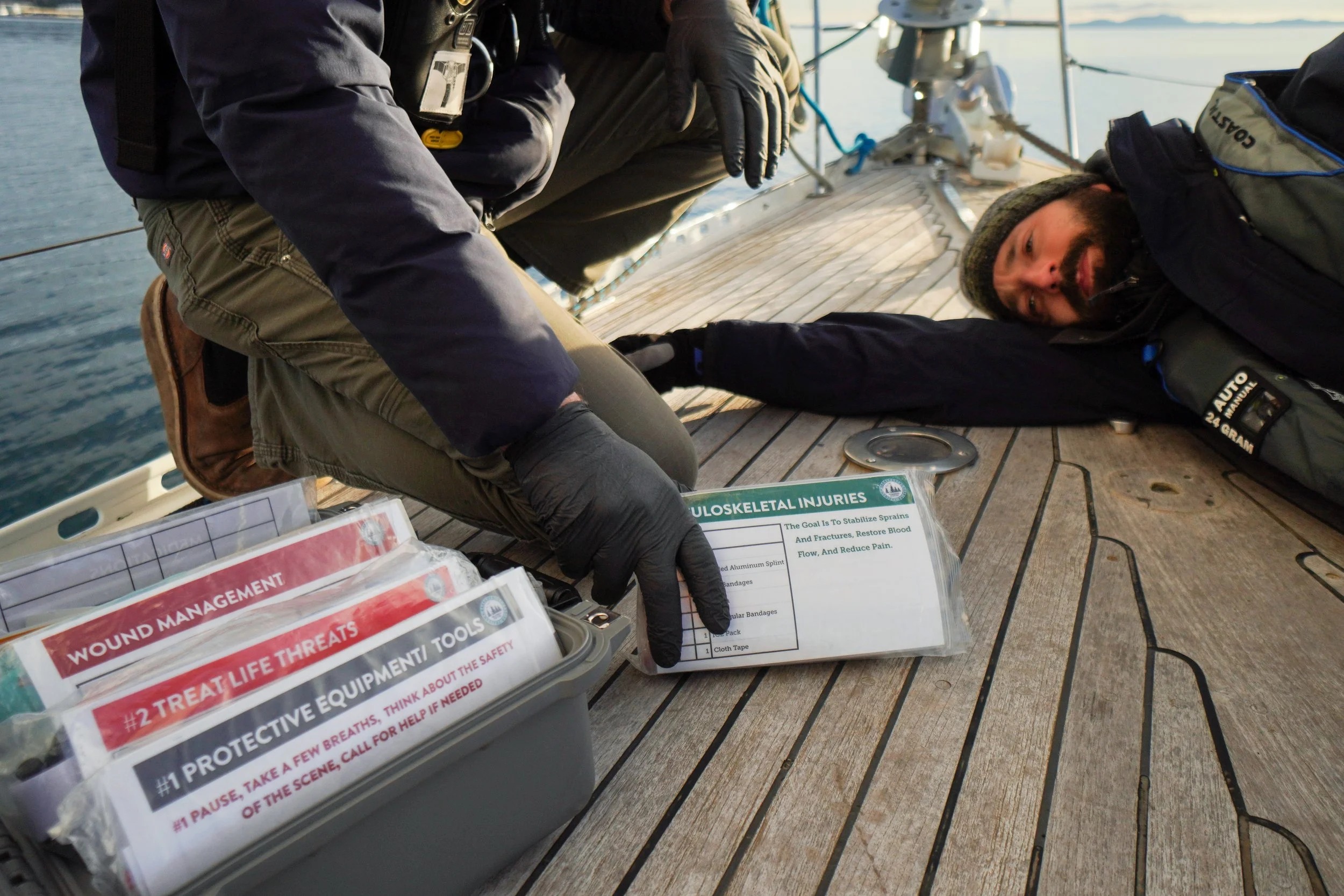
Buy a high-quality commercial kit. Then customize it.
That gives you:
A solid baseline
A reasonable cost
A curated selection of essentials
A starting point you can tune to your boat, your crew, and your cruising grounds
Then add what matters for your crew:
A real tourniquet
Trauma shears
Seasickness meds the crew has used before
A better blister kit
A SAM splint if you've got the stowage
Sea bands, Dramamine, and extra electrolyte
Extra gloves (saltwater wrecks gloves faster than you think)
Pre-built structure plus personal tailoring is, in our experience, the best of both worlds.
We built the MMG Coastal Cruiser Kit for sailors who want a baseline that has passed the smell test. Real CAT tourniquet. Real chest seal. QuikClot. Trauma shears. Full wound-management section with cleaning, closing (steri-strips, skin glue, tincture of benzoin), and proper bandaging. Splint, ace wraps, triangular bandages, coban. Burn dressings. A meds module designed for a small crew at sea with Tylenol, ibuprofen, aspirin, Benadryl, Dramamine, Pepto, Pepsid, loperamide, hydrocortisone — plus eye drops, swimmer's ear drops, and a sea band. A dental medic kit for the molar that always cracks 200 miles offshore. The MMG Manual and a laminated quick guide so the most useful information isn't buried in a wet bag at the bottom of a locker.
Whether you buy ours or someone else's, the principle is the same: start with something curated by people who actually use this stuff at sea, then make it yours.
The Case for the Case
A note worth making for the maritime crowd: the container is part of the kit. Hard-shell, waterproof, gasketed, and ideally floats. Pelican-style is great. So is an old pretzel jar if it seals. The contents inside should be individually wrapped both for moisture protection and because it lets you keep the kit organized in modules. If your kit has lived a hard year aboard, salt and humidity will have done more damage than any patient ever could. Inspect annually.
The "Omit Kit": The Philosophy That Saves Weight and Makes You Smarter
One of the concepts we teach at Maritime Medical Guides is the Omit Kit.
Here's how it works:
Start with a well-stocked, well-thought-out kit.
Remove things — intentionally — because you have a rationale for not bringing them.

This forces you to consider:
Where am I going? (Coastal day-sail, weeklong cruise, offshore passage?)
How far will I be from definitive care?
What does the crew's medical history look like?
Does anyone on board have training, and to what level?
Do I have a sat phone, telemedicine support, or a partner clinic?
What can I cannibalize from the boat itself? (Sail ties, rigging tape, halyards, towels — a sailboat is a floating splint factory.)
Example: A weekend coastal cruise in known waters with a crew of three, all healthy adults, with cell coverage and a working VHF — you can probably omit the deeper medication module and most of the heavy trauma redundancy.
Bring:
Strong wound-management section
One real tourniquet, one chest seal, one QuikClot
The basics of the meds module (anti-inflammatories, seasickness, GI)
A splint or compression bandage
A laminated reference
The kit shrinks. You made the call on purpose.
The Omit Kit philosophy:
Protects you from overpacking
Keeps stowage manageable on a small boat
Avoids the "I brought a medical closet" avalanche when you open the locker
Builds actual medical reasoning into your passage planning
So, Improvise or Not? Here's the Real Answer.
Improvising skills = essential.
Improvised kits = often more expensive, heavier, less effective, and more confusing.
Best practice = buy a good kit → customize for your boat and crew → omit what you don't need.
You end up with:
A kit you actually understand
The right gear for your cruising grounds
A manageable footprint in the locker
Reliable, approved tools (not rubber-band tourniquets)
Confidence to handle the things that go wrong at sea — from a sliced finger in the galley to a real bleed in heavy weather
And here's the truth: your kit should evolve with your experience. Every passage, every season, every minor patch-up — you'll refine it. Eventually it becomes something unique to your boat. Not because you improvised everything, but because you curated it with intention.
Final Takeaway
Build your skills. Buy your baseline. Modify for your boat and crew. Improvise only when appropriate. And whenever possible, avoid rubber-band tourniquets.
Your future self, and your crew, will thank you.
MMG’s Kits
We sell three kits: Dinghy, Coastal, Offshore. They are scaled based on distance from definitive care. The same philosophy goes for all three: start with the right baseline, then make it yours. All three MMG kits are available in our Shop. Built by mariners, for mariners — with the gear we carry aboard.